Exploring the Art of Black and White Photography
My artistic roots are solidly in black and white photography. It was my introduction to the medium when I was a boy hanging out in my Dad’s darkroom, and is still my first and greatest love. Black and white photographs have a classic look that captures the essence of a subject when color photographs often cannot. The absence of color allows me to focus on composition, texture, and the interplay of light and shadow, a simpler palette that requires more nuanced interpretation on my part in order to convey my intent in making a photograph. It can lead to a more compelling, powerful photograph.
Today’s black and white photographers trace their roots back to a pioneering group of photographers in California that included Edward Weston, Imogen Cunningham and, of course, Ansel Adams. I’ve learned so much by studying the work of these and many other classic photographers, and I believe that their influence is obvious in my work.
Every Calf Needs Their Mother
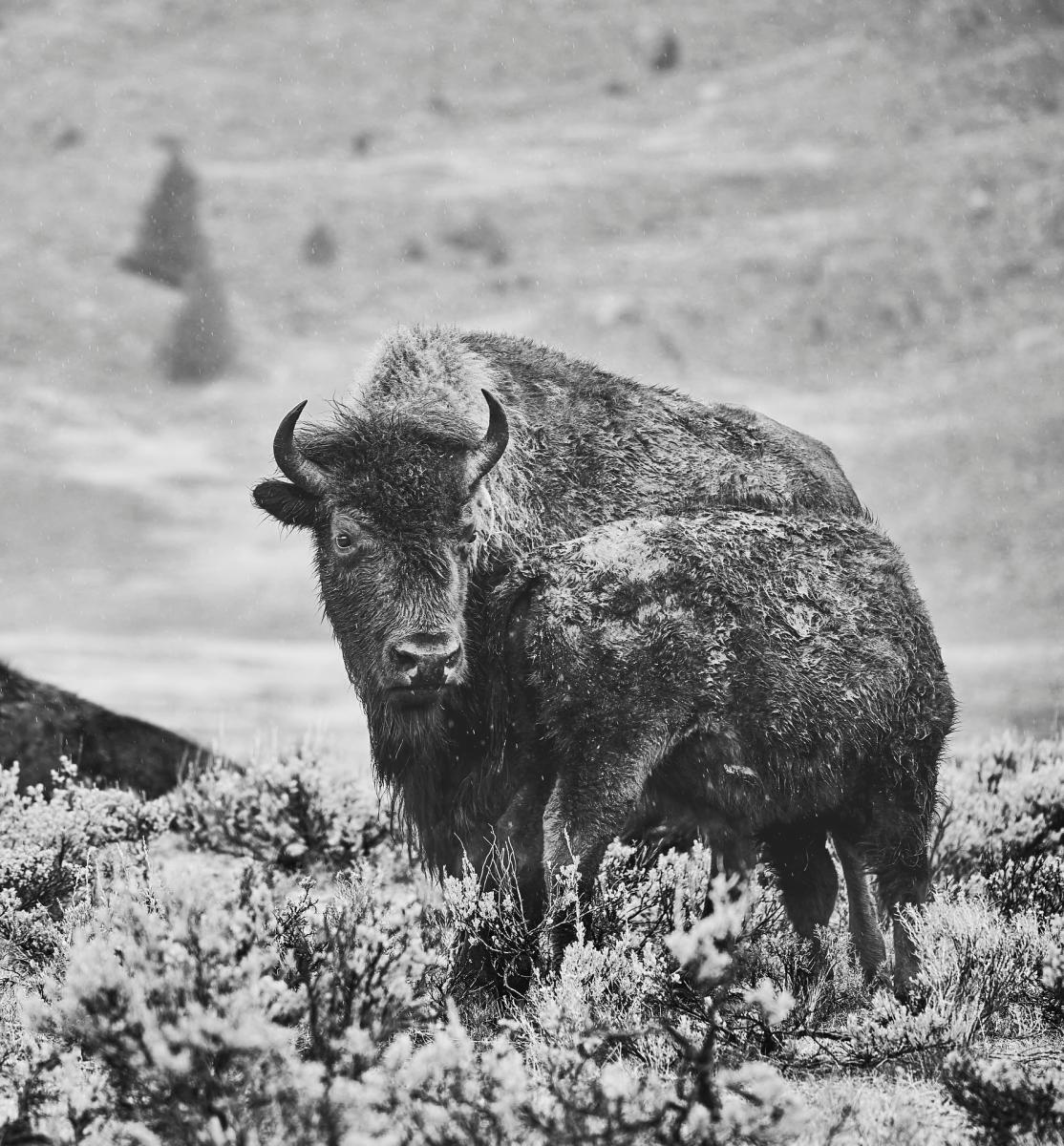
The Bison in Yellowstone National Park are the only bison in the States who have remained on the same land continuously for around 10,000 years. Scientists estimate that there were between 30 and 50 million bison in North America in 1700, by 1900 they were nearly extinct, the number having fallen to just a couple hundred souls. In Yellowstone the number of surviving bison dropped to just a couple dozen wild, native bison living in the park’s interior, in Pelican Valley. In 1902 Yellowstone’s managers purchased 21 bison to be used in a captive breeding program, eventually these bison were allowed to mix with those remaining in the park. Currently there are around 5000 bison living in 2 distinct herds in Yellowstone. The mating season is late summer and the calves generally arrive from April - June. They grow quickly and are soon eating grass on their own and keeping up with the migrating herd, but they rely on their mothers and nurse for most of their first year of life. In this photo, made October 7, 2021, a calf of about 6 months is during and huddling close to their mother during a cold autumn sleet storm. I always feel a bit of remorse for the new calves, who have no idea what is about to happen to their world when winter hits Yellowstone, where temps have dropped to -66 degrees F. They will develop thick winter coats and are well adapted for the conditions, but they will be relying on Mum for food and warmth until spring returns to Yellowstone. “Every Calf Needs Their Mum”