Exploring the Art of Black and White Photography
My artistic roots are solidly in black and white photography. It was my introduction to the medium when I was a boy hanging out in my Dad’s darkroom, and is still my first and greatest love. Black and white photographs have a classic look that captures the essence of a subject when color photographs often cannot. The absence of color allows me to focus on composition, texture, and the interplay of light and shadow, a simpler palette that requires more nuanced interpretation on my part in order to convey my intent in making a photograph. It can lead to a more compelling, powerful photograph.
Today’s black and white photographers trace their roots back to a pioneering group of photographers in California that included Edward Weston, Imogen Cunningham and, of course, Ansel Adams. I’ve learned so much by studying the work of these and many other classic photographers, and I believe that their influence is obvious in my work.
Bison, Blizzard
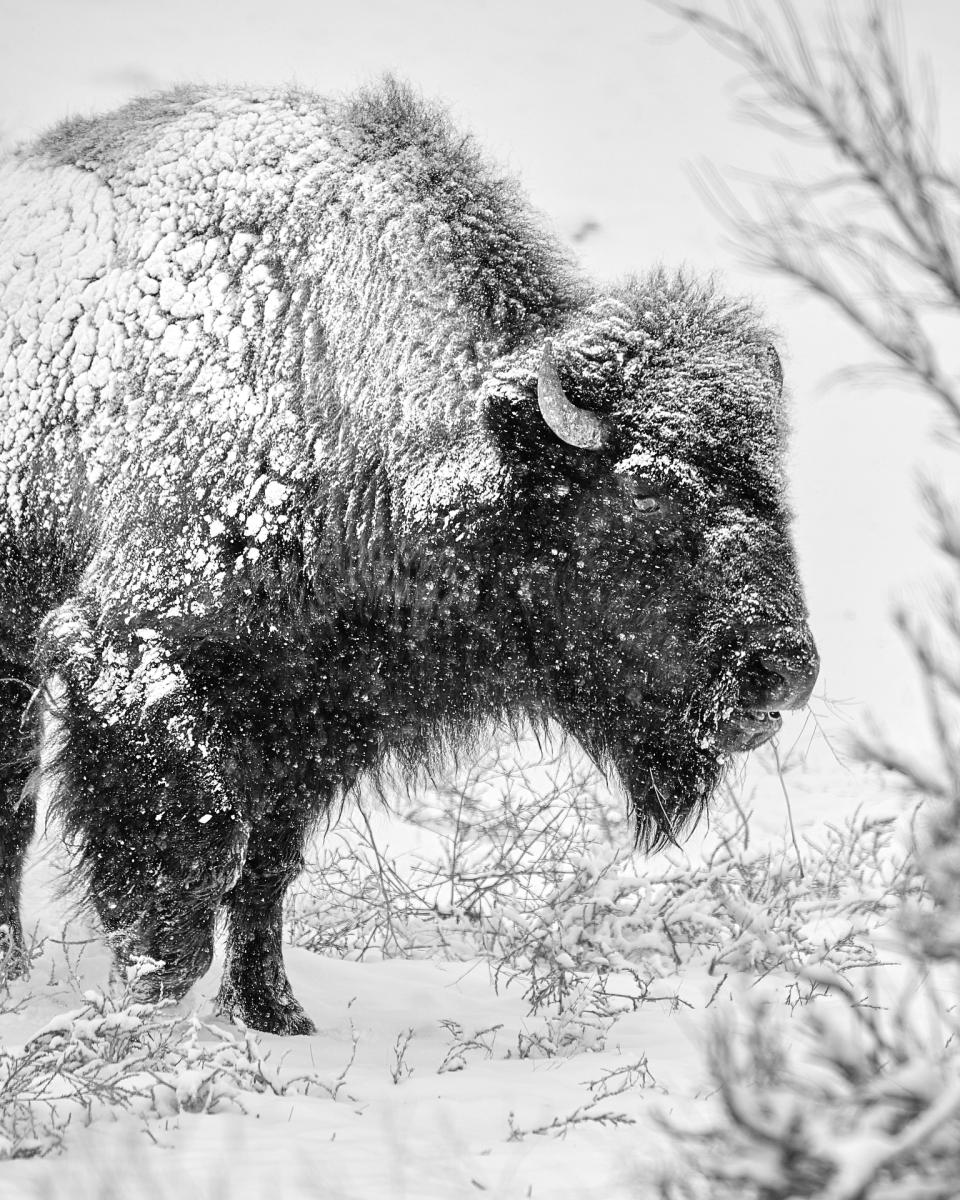
The Bison in Yellowstone National Park are the only bison in the States who have remained on the same land continuously for around 10,000 years. Scientists estimate that there were between 30 and 50 million bison in North America in 1700, by 1900 they were nearly extinct, the number having fallen to just a couple hundred souls. In Yellowstone the number of surviving bison dropped to just a couple dozen wild, native bison living in the park’s interior, in Pelican Valley. In 1902 Yellowstone’s managers purchased 21 bison to be used in a captive breeding program, eventually these bison were allowed to mix with those remaining in the park. By the beginning of the winter of 2022 / 2023 there were an estimated 6000 bison in the park. That was a very cold winter with lots of deep snow, even in the northern range where snow depth is generally much less than other areas of the park. The bison have genetically been selected to shrug off cold and snow as long as they can access food and water, and they followed ancestral migration routes along the Yellowstone River, to the meadows and sagebrush steppe along the river north of Gardiner, Montana. However, the river soon flows out of the park into National Forest and private land, where bison are legal game for a few lucky license -holders and the members of 7 Native American tribes with hunting rights guaranteed by treaty. A kill quota is set by The Interagency Bison Management Plan, drafted by a political committee, rather than set by scientific methods due to the region’s powerful livestock owners lobbyists. Despite being America’s national mammal, not everyone wants them living free on the landscape, competing with cattle for public grazing lands. Over the winter of 22/23 about 1600 wild, native, free-roaming bison were slaughtered. These animals had no fear of humans and trustingly walked right up to their doom. Photo was made on March 6, 2023 along Old Yellowstone Trail, in Yellowstone National Park. “Bison, Blizzard - 2023”